


Cryptocurrency sounds complicated until someone explains it in plain language — and then it turns out the hard part is not understanding it, but buying it safely. Every week, beginners lose money to the same handful of avoidable mistakes: buying on a shady platform, paying a huge card fee they did not expect, leaving coins on an exchange that freezes, or handing their recovery phrase to a “support agent” who was actually a scammer. None of that has to happen to you.
This guide walks you through buying your first cryptocurrency step by step, the safe way: choosing a legitimate exchange, paying the lowest reasonable fee, storing your coins properly, and steering clear of the scams that target newcomers. No hype, no “get rich quick” promises — just the practical process that experienced buyers wish someone had shown them on day one. If you are still weighing up which way of earning online suits you, our earning ideas hub compares the main options side by side.
What Is Cryptocurrency, in Plain English?
A cryptocurrency is digital money that runs on a shared public ledger called a blockchain instead of a bank’s private database. Bitcoin (BTC), launched in 2009, was the first and remains the largest. Ethereum (ETH) is the second-largest and powers a huge ecosystem of apps, from trading platforms to digital collectibles. Thousands of smaller coins, called altcoins, exist alongside them — most far riskier than the top two.
Three facts surprise most beginners. First, you do not need to buy a whole coin: Bitcoin trades in fractions, so $25, €25, or £25 buys you a small slice of one. Second, crypto prices are extremely volatile — double-digit percentage swings in a single week are normal, and prices can fall sharply and stay down for months. Third, crypto transactions are effectively irreversible: if you send coins to the wrong address or to a scammer, there is no bank to call to reverse it. That last point is why security habits matter more here than in any other kind of investing.
Bitcoin’s total supply is capped at 21 million coins, which supporters point to as a built-in scarcity. Whether that makes it a good investment is a separate question — and one this article will not answer for you. Treat anything you put into crypto as money you could afford to lose entirely, and never invest borrowed money or money you need for rent, bills, or food.
Before You Buy: 4 Questions to Answer First
1. How much can you truly afford to lose? Pick a small starting amount — many guides suggest a first purchase of $25–$100 (or the equivalent in your currency) purely to learn the process. Your first buy is tuition, not a retirement plan.
2. What is your goal? A long-term holder and someone hoping to trade daily need completely different setups. Beginners do far better as long-term holders: buy a little, regularly, and ignore the daily charts.
3. What are the rules where you live? Crypto regulation varies enormously by country. Some countries tax crypto gains, some restrict which platforms can operate, and a few ban it outright. Check your local tax authority’s guidance before you buy — in many countries, selling crypto or swapping one coin for another is a taxable event even if you never cashed out to your bank.
4. Are you about to be rushed? Scammers thrive on urgency: “buy now before the price explodes,” “limited presale,” “send coins to double them.” A legitimate investment will still exist tomorrow. If anyone is pressuring you to act today, walk away.
How to Choose a Safe Exchange
For your first purchase, a large, regulated centralised exchange is the simplest and safest route. These are companies like Coinbase, Kraken, and Binance (availability varies by country), which operate much like an online bank: you create an account, verify your identity, deposit money, and buy. The alternatives — decentralised exchanges and peer-to-peer trading — give you more control but also more ways to make an expensive mistake, so leave them until you are comfortable.
| Check this | What “good” looks like | Red flag |
|---|---|---|
| Regulation & reputation | Licensed/registered in your country, operating for years, large user base | Unknown company, no physical address, brand-new app with big ads |
| Identity verification (KYC) | Requires government ID and a selfie/video check | Lets you deposit and trade large sums with zero verification |
| Security features | App-based two-factor authentication (2FA), withdrawal address whitelisting, anti-phishing codes | SMS-only 2FA, no security settings at all |
| Fee transparency | Shows the full fee before you confirm the buy | Hides fees in the exchange rate, surprises at checkout |
| Withdrawal record | Users routinely withdraw to their own wallets without issues | Reports of frozen withdrawals or “account reviews” that never end |
A useful rule of thumb from experienced buyers: stick to an exchange ranked in the top 20 by trading volume, and be deeply suspicious of any platform you first heard about through a social media ad, a direct message, or an influencer’s “exclusive link.” If you want a broader sense of how people earn online before committing money to crypto, our guide on making money online for beginners covers 17 legit methods, most of which need no upfront investment at all.
Step by Step: Buying Your First Crypto
Step 1 — Create your account on the official site only. Type the exchange’s web address yourself or use its official app from your phone’s app store. Never click an exchange link from an email, ad, or direct message — phishing sites copy real exchanges pixel for pixel. Bookmark the real site once you are sure you have it.
Step 2 — Verify your identity. Regulated exchanges must verify who you are (called KYC). Expect to upload a government photo ID and take a selfie or short video. Automated checks often complete in minutes; manual reviews can take a day or two. This is normal and is actually a good sign — a platform that skips it is cutting corners on the law.
Step 3 — Lock down security before depositing anything. Turn on app-based 2FA (Google Authenticator or a similar app) — not SMS codes, which can be stolen through SIM-swapping. Use a unique, strong password and a dedicated email address for your exchange account if you can. Enable withdrawal address whitelisting if the exchange offers it: it means coins can only be sent to addresses you have pre-approved.
Step 4 — Deposit with a bank transfer, not a card. Bank transfers are usually the cheapest way to fund an account — often free or a small flat fee. Card purchases are instant but routinely cost several percent of the transaction (some guides report card fees near 4%), which quietly eats a big chunk of a small first purchase. Check the fee screen before confirming anything.
Step 5 — Place your buy. Choose Bitcoin or Ethereum for your first purchase — both have decade-long track records and deep liquidity, which is why they are the standard beginner recommendation. A market order buys immediately at the current price; a limit order buys only at a price you set. For a first buy, a simple market order for a small amount is fine. Remember you are buying a fraction, not a whole coin.
Step 6 — Send a small test withdrawal to your own wallet. Before moving your full amount, withdraw a tiny sum to a wallet you control and confirm it arrives. This one habit prevents the most painful beginner error: sending coins to the wrong address or the wrong blockchain network. Always match the coin to a wallet that supports that exact network — Bitcoin to a Bitcoin address, Ethereum to an Ethereum address.
Step 7 — Decide where the rest lives. Keep a small amount on the exchange if you plan to trade soon; move anything you intend to hold for weeks or longer into your own wallet. Exchanges are trading venues, not banks — history has repeatedly shown that platforms can freeze withdrawals, get hacked, or collapse, and customers are left waiting.
Hot Wallets vs Cold Wallets: Where Should Your Coins Live?
| Hot wallet (software) | Cold wallet (hardware) | |
|---|---|---|
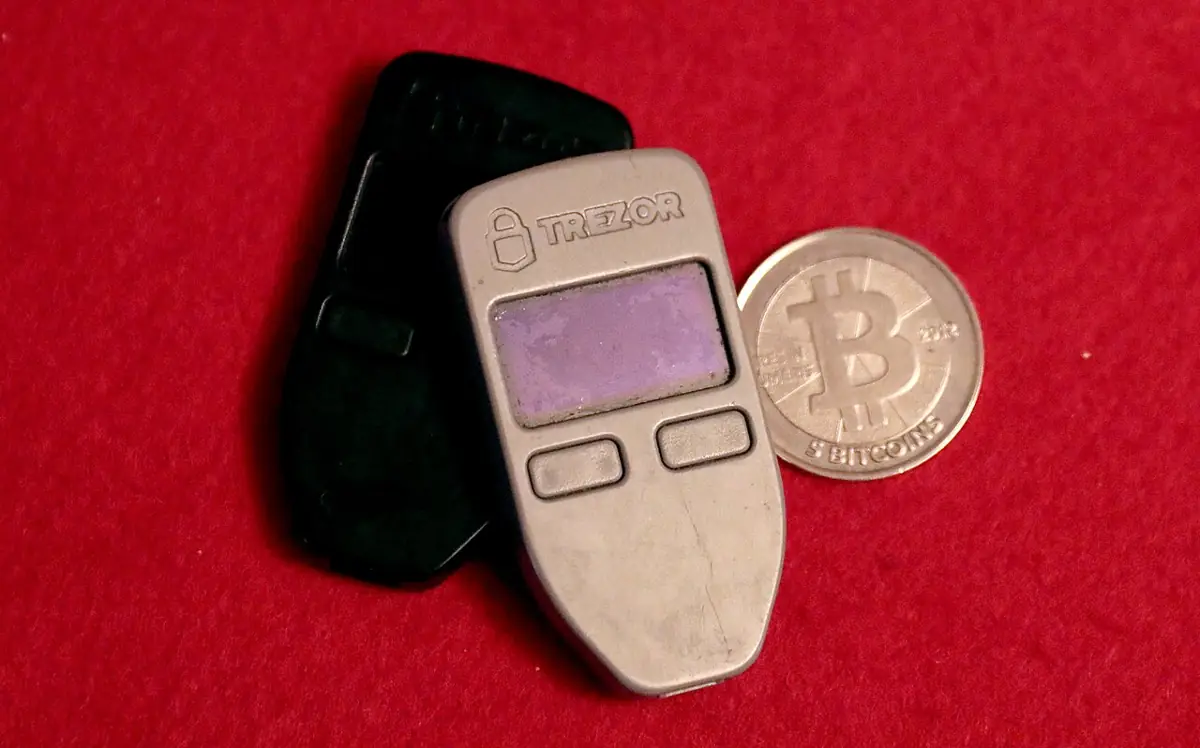
| What it is | An app on your phone or computer (e.g. MetaMask, Trust Wallet) | A physical device that keeps keys offline (e.g. Ledger, Trezor) |
| Best for | Small amounts, frequent use | Long-term holdings, larger amounts |
| Cost | Usually free | Typically $50–$150 for the device |
| Risk | Exposed to phone/computer malware | Keys never touch the internet; you must not lose the device or its backup |
Whichever you choose, you will receive a recovery phrase of 12–24 words when you set it up. This phrase is your wallet: anyone who has it can take everything in it, and if you lose it, no company can restore your coins. Write it on paper, store it somewhere safe (a fireproof safe or bank deposit box for larger holdings), and never photograph it, email it, store it in cloud notes, or type it into any website. Real support staff will never ask for it — anyone who does is a scammer, full stop.
What Should a Beginner Buy First?
The boring answer is the right one: start with Bitcoin and Ethereum. They are the two coins with the longest track records, the deepest markets, and the least chance of going to zero overnight. A common beginner approach is a “core” of BTC and ETH with, at most, a small slice in a couple of well-known larger altcoins — and nothing at all in memecoins, presale tokens, or coins promoted mainly by influencers.
The second boring answer is also the right one: buy a little, regularly, instead of all at once. This is called dollar-cost averaging (DCA). You might set up an automatic buy of $25 or €25 every week, whatever the price. DCA does not guarantee profits — nothing does — but it removes the two emotions that destroy beginners: panic-buying when prices spike and panic-selling when they crash. Most major exchanges let you automate recurring buys, so you can set it and ignore the charts. Over time, some holders also explore staking — locking up coins like ETH to help secure a network in return for rewards, typically in the low single digits percent per year depending on the coin and network. Treat staking as a side topic to learn later, not a reason to buy a coin. Our roundup of passive income ideas puts staking in context alongside 19 other income methods.
7 Beginner Mistakes (and Scams) to Avoid
1. “Guaranteed” or “doubled” returns. Any scheme promising fixed daily profits, doubled coins, or risk-free returns is a scam. Legitimate investments never guarantee returns, and crypto’s volatility makes guarantees absurd on their face.
2. Fake support agents. After posting a question in a forum or on social media, beginners often get direct messages from “support” asking for their recovery phrase to “fix” an account. Real support never asks for it. Assume every unsolicited DM is a scam.
3. Giveaway and impersonation scams. Fake celebrity or exchange accounts promise to multiply any crypto you send them. No giveaway asks you to send money first. Ever.
4. Sending to the wrong network. Double-check the coin, the network, and the full address before confirming. Copy-paste errors and wrong-network transfers are usually unrecoverable.
5. Keeping everything on one exchange. Use exchanges for buying and selling, not for long-term storage. Move holdings you are not actively trading into a wallet you control.
6. Investing money you cannot lose. Never put rent money, emergency savings, or borrowed funds into crypto. If a price drop would change your life, the position is too big.
7. Trading on emotion. Chasing a coin because it is “mooning” on social media, or selling in a panic during a dip, is how beginners buy high and sell low. A written plan — what you buy, how much, how often — beats gut feeling every time. For more on spotting dodgy schemes in general, see our guide to common online earning scams and the red flags they share.
Pros and Cons of Buying Crypto as a Beginner
Pros: you can start with a very small amount; buying on a regulated exchange is now a straightforward, minutes-long process; Bitcoin and Ethereum are genuinely accessible worldwide assets; and learning the mechanics (wallets, security, transfers) is a useful digital skill in itself.
Cons: extreme volatility — you can lose a large share of your money quickly; irreversible transactions mean mistakes are permanent; scams are everywhere and constantly evolving; and the tax and legal rules in your country may be complex or restrictive. Weigh both lists honestly before your first buy, not after.
Frequently Asked Questions
How much money do I need to start buying crypto?
Most major exchanges let you start with as little as $10–$25 (or the equivalent in your currency). A small first purchase is the smart move: it lets you learn the whole process — deposit, buy, withdraw, store — without meaningful risk.
Is Bitcoin or Ethereum better for beginners?
Both are reasonable first choices. Bitcoin is the oldest, most widely recognised, and simplest to understand; Ethereum powers a much larger ecosystem of applications. Many beginners split their first purchases between the two rather than betting everything on one.
Do I need ID to buy cryptocurrency?
Yes, on any regulated exchange. Expect a government photo ID and a selfie or video check. Platforms that let you trade significant sums with no verification at all are operating outside the rules — avoid them.
Is it safe to keep crypto on an exchange?
For small amounts you plan to trade soon, it is acceptable. For anything you intend to hold long-term, move it to a wallet you control — ideally a hardware wallet for larger amounts. The phrase to remember is “not your keys, not your coins.”
Can I lose all my money in crypto?
Yes. Prices can crash, platforms can fail, and scams can drain wallets. That is why the golden rule is never to invest money you cannot afford to lose, and never to borrow in order to buy crypto.
Your First-Week Checklist
Here is the whole process boiled down to one week. Day 1: pick a regulated exchange available in your country and create your account on the official site. Day 2: complete identity verification and turn on app-based 2FA. Day 3: deposit a small amount by bank transfer and buy a fraction of Bitcoin or Ethereum. Day 4: set up your own wallet, write down your recovery phrase on paper, and send a small test withdrawal. Day 5: move the rest of your holding to your wallet. Day 6: set up a small recurring buy if you plan to invest regularly — and then stop watching the price every hour. Day 7: read up on your country’s tax rules for crypto so there are no surprises later.
Cryptocurrency rewards patience and punishes haste. Buy small, buy on a platform you trust, secure your own keys, and ignore anyone promising shortcuts. Do that, and your first crypto purchase will be an uneventful one — which, in this market, is exactly the outcome you want. If crypto turns out not to be your thing, our Earning Path Finder quiz can point you toward an earning method that fits your skills and available time better.
Disclaimer: This article is for education only and is not financial advice. Cryptocurrency is volatile and risky; do your own research and consider speaking to a qualified financial adviser before investing.
Featured image: Photo by Gage Skidmore on Wikimedia Commons (CC BY-SA 3.0).
